H2Osolutions FL I Plumbing Services | Best Miami Plumber
 +1 (786) 627-94-72
H2Osolutions FL I Plumbing Services | Best Miami Plumber
+1 (786) 627-94-72

 17.06.2026
 7 min.
 Share
Share


The efficiency of a kitchen's waste system isn't a matter of "best effort"—it is a calculation of hydraulic balance. Beneath your countertop, a specific set of diameters and clearances dictates whether your sink functions as a high-performance workstation or a source of chronic moisture damage. As a professional engineer, I view the drain not just as a pipe, but as a gravity-fed transport system designed to maintain "scouring action"—the velocity required to move solids without leaving residue behind.
For those currently standing in a hardware store aisle or evaluating a leak, here are the non-negotiable specifications for a standard North American residential kitchen:
In North American residential engineering, the 1.5-inch (1-1/2") nominal diameter is the benchmark for kitchen waste lines. This dimension applies to the P-trap—the U-shaped pipe that holds a water seal to block sewer gases—and the subsequent piping connecting to your home's main waste stack.
This standard is codified in the International Plumbing Code (IPC) and Uniform Plumbing Code (UPC) [1]. From a design perspective, this size is optimized to handle the discharge of modern high-output faucets, which typically deliver between 1.8 and 2.2 GPM (gallons per minute) at 60 PSI (pounds per square inch) [2]. If you downsize this line, you create a bottleneck; if you upsize it unnecessarily to a 2-inch line without proper flow, you lose the fluid velocity needed to carry food particles away, leading to premature sedimentation and clogs [13].
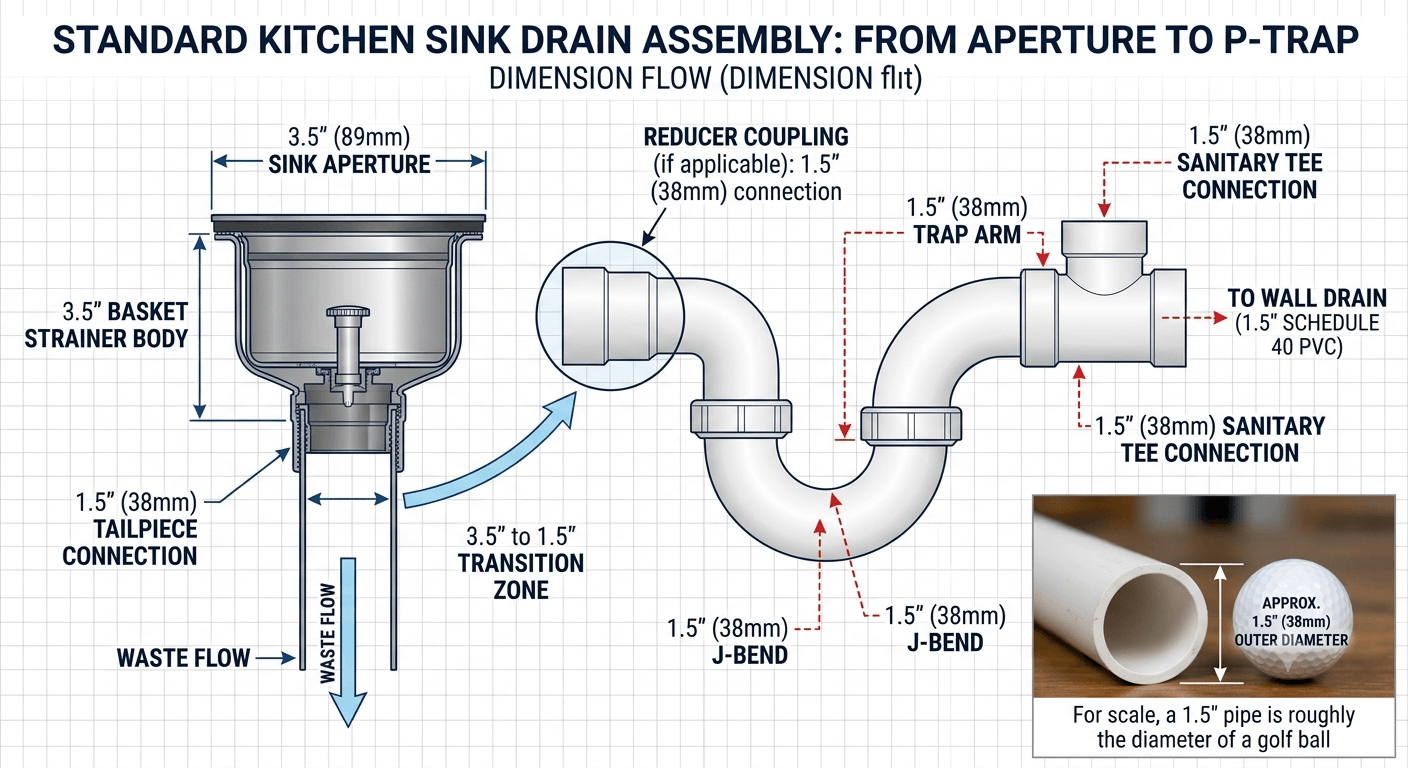
Technical schematic showing the transition from a 3.5" sink aperture to a 1.5" P-trap assembly. For scale, a 1.5" pipe is roughly the diameter of a golf ball.
A kitchen drain is a modular assembly where precision at the joints determines the lifespan of your cabinetry.
1. The Strainer & Flange: The entry point where the basket meets the sink basin.
2. The Tailpiece: The vertical section connecting the strainer to the trap.
3. The P-Trap: The critical hydraulic seal. To function correctly, the "trap arm" (the horizontal pipe after the trap) must be at least 3 inches long—or twice the pipe diameter—to prevent siphoning, which is the unintended suction of the water seal out of the trap [3].
A common failure point I see in South Florida homes involves the slip-joint connections. These rely on a compression washer and nut. Overtightening often leads to stress fractures in plastic components, while undertightening results in "slow-weep" leaks that can rot a subfloor long before you notice a puddle.
The interface between the metal flange and the sink requires a watertight barrier. While traditional plumber's putty is a staple, it is an oil-based product. For homeowners with granite, marble, or quartz, this is a risk: the oils can leach into the porous stone, creating a permanent, dark "shadow" around the drain.
In these cases, you must specify a 100% silicone sealant or a specialized "stain-free" putty [5, 6]. If using silicone, be aware of the engineering timeline: while it "skins" over in 10-30 minutes, a full hydraulic cure (reaching maximum strength) requires 24-48 hours [4]. In low-humidity environments, this process can actually take significantly longer, sometimes up to 10 days to reach maximum chemical resistance [4].
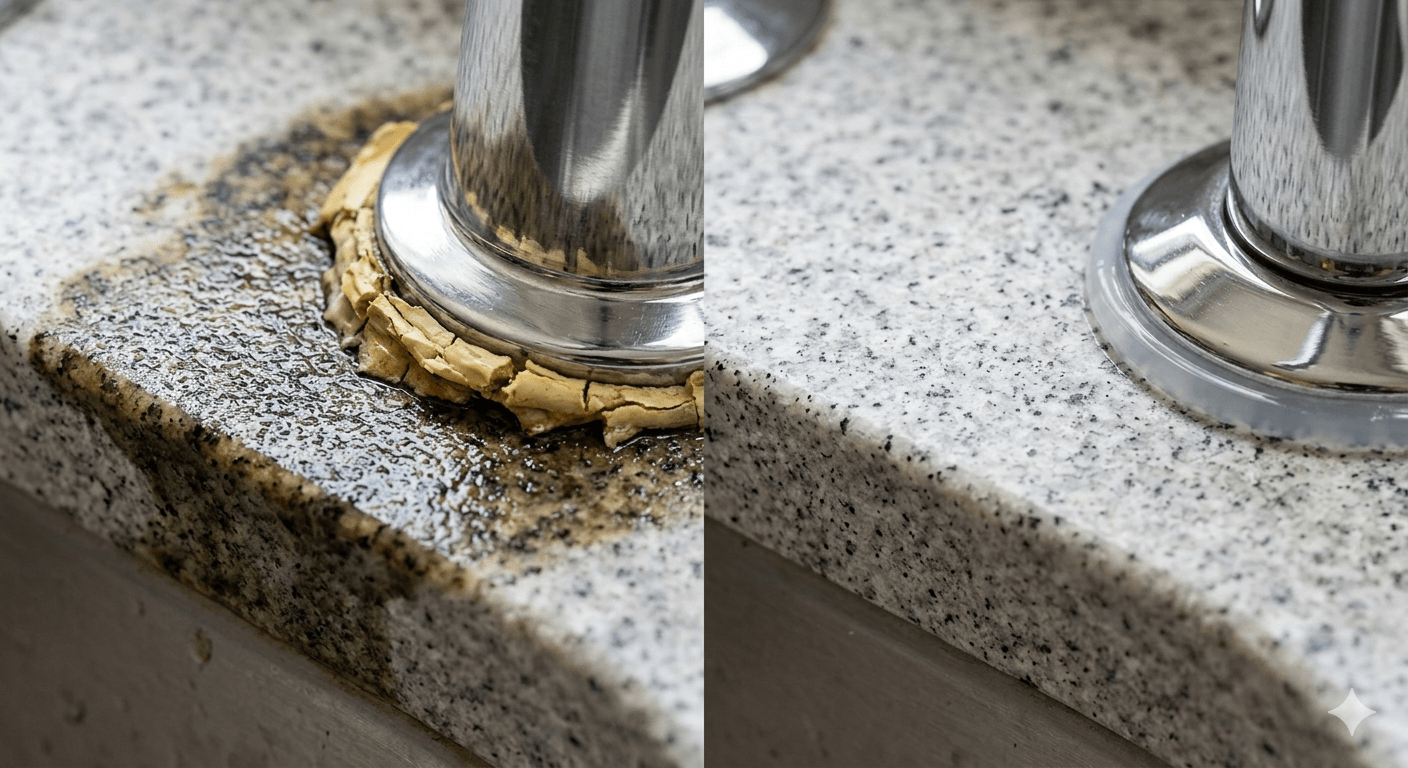
Macro view of oil-leaching damage caused by using standard putty on a porous granite sink vs. a clean silicone installation.
Before heading to the supplier, you must distinguish between the sink opening and the pipe diameter.
However, "nominal" does not mean "actual" in engineering. A standard Schedule 40 PVC pipe (the thick-walled white plastic pipe) has an Outer Diameter (OD) of 1.90 inches [7]. If the pipe ends are inaccessible, use a flexible tape to measure the circumference and divide by Pi (3.14159) to confirm your diameter [8].
| Component | Engineering Spec | Primary Function |
|---|---|---|
| Sink Opening | 3.5" | Standardized basin aperture |
| Strainer Flange | 3.5" | Mechanical seal interface |
| Drain Pipe (P-Trap) | 1.5" | Hydraulic transport & gas seal |
Adding a garbage disposal transforms the drain into a motorized junction. The disposal receives waste from the basin and often serves as the entry point for dishwasher discharge.
For these systems, the "High Loop" is a critical code requirement. The dishwasher drain hose must be looped to a minimum height of 32 inches (81.5-82 cm) before connecting to the disposal [9, 14]. This prevents "cross-contamination"—where dirty sink water backflows into your clean dishwasher. Furthermore, the horizontal run of a 1.5-inch trap arm cannot exceed 42 inches before reaching a vent stack [10]. Exceeding this distance risks siphoning the P-trap dry, allowing methane (sewer gas) into your kitchen.
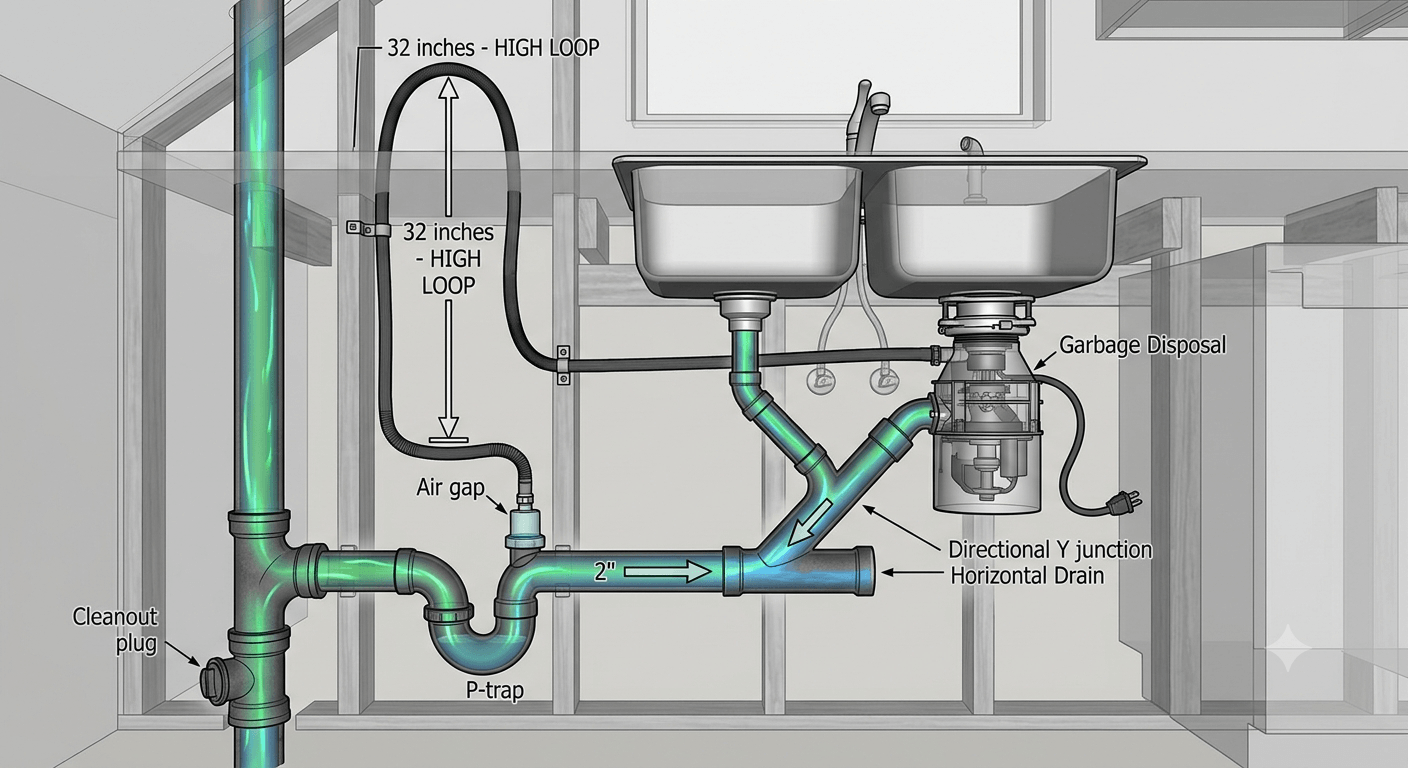
3D X-ray view of a double-basin sink with a disposal. Note the 32-inch high loop on the dishwasher line and the directional "Y" junction for smooth flow.
Knowing when to put down the wrench is the difference between a $50 fix and a $5,000 restoration.
| Scenario | Risk Level | Action |
|---|---|---|
| Replacing a PVC P-trap | Low | Safe DIY. Follow standard 1.5" specs. |
| Installing a disposal on a new sink | Moderate | DIY Possible. Ensure "High Loop" compliance. |
| Corrosion on metal wall stub-out | High | STOP. Call a professional. Risk of pipe shear. |
| Persistent gurgling or sewer odors | High | STOP. Indicates a venting or main line failure. |
In our South Florida service area, we frequently encounter legacy infrastructure—specifically cast iron or galvanized steel. These materials have a design life of 40 to 70 years [11]. If you see "blistering" (tuberculation) or white zinc oxide powder on your pipes, the metal is structurally compromised.
The Engineering Warning: Do not attempt to force a wrench onto a corroded galvanized nipple protruding from the wall. These pipes often snap at the threads, turning a minor trap replacement into a multi-thousand-dollar wall-opening repair [11]. If you hear "gurgling" when the sink is empty, the issue isn't a simple clog—it's a venting failure or a siphoned trap. This is a health hazard that requires professional diagnostic tools, such as a camera inspection, to locate the blockage in the vent stack.
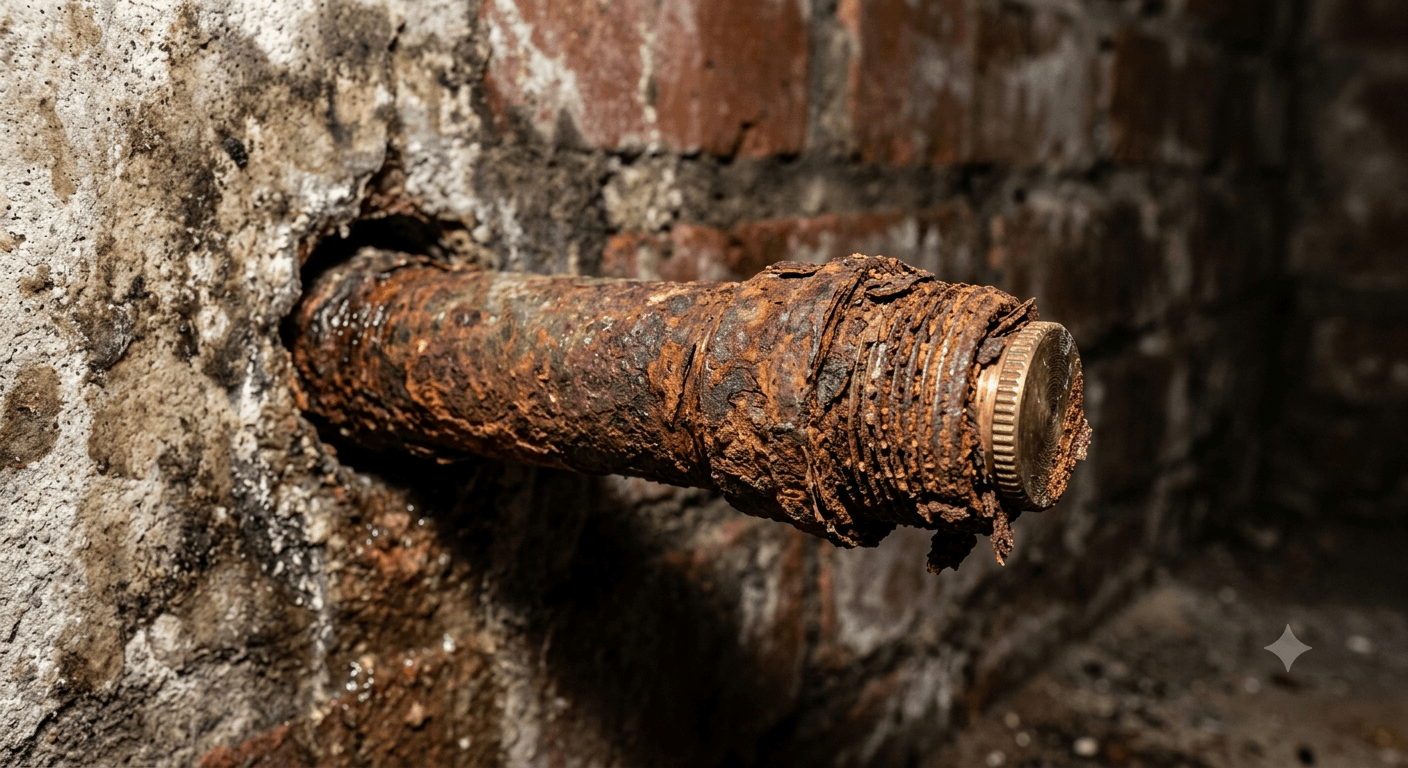
A galvanized wall stub-out showing advanced oxidation. If your pipes look like this, stop and call a professional before the threads shear off.
A common misconception is that boiling water or caustic cleaners "clear" grease. In reality, heat simply moves the grease further down the line until it reaches a cooler section of the pipe, where it solidifies into a harder-to-reach obstruction.
Instead of corrosive acids that can soften PVC, I recommend enzyme-based cleaners. These utilize aerobic and anaerobic bacteria (microorganisms that thrive with or without oxygen) to break down triglycerides and fatty acids [12]. For maximum efficacy, these should be activated with water at 30-40°C and allowed to dwell for at least 20 minutes [12].
Go to your sink and look at the pipe exiting the wall. If it is metallic and shows signs of orange rust, "bubbling" paint, or white crust, do not attempt to disassemble it yourself. The integrity of those threads is likely gone. Contact a specialist for a camera inspection to verify the line before a five-minute project turns into a major flood.
[1] Plumbing Codes (IPC/UPC) and Trap Arms — (https://up.codes/s/traps-protected-by-vent-pipes)
[2] Flow rates and drain standards — (https://www.aimfaucet.com/ru/blog/tech/best-faucet-gpm-for-kitchen/)
[3] Plumbing Codes (IPC/UPC) and Trap Arms — (https://up.codes/s/traps-protected-by-vent-pipes)
[4] Sealants and Bio-cleaners data — (https://www.junbond.com/news/silicone-sealant-usage-steps-and-curing-time/)
[5] Appliance installation and stone care — (https://theproperkitchen.com/how-many-hours-does-it-take-to-install-a-dishwasher/)
[6] How to properly use plumbers putty — (https://www.oatey.com/faqs-blog-videos-case-studies/blog/how-properly-use-plumbers-putty-tips-mistakes-avoid-and-when-use)
[7] Flow rates and drain standards — (https://www.aimfaucet.com/ru/blog/tech/best-faucet-gpm-for-kitchen/)
[8] Flow rates and drain standards — (https://www.aimfaucet.com/ru/blog/tech/best-faucet-gpm-for-kitchen/)
[9] Appliance installation and stone care — (https://theproperkitchen.com/how-many-hours-does-it-take-to-install-a-dishwasher/)
[10] Plumbing Codes (IPC/UPC) and Trap Arms — (https://up.codes/s/traps-protected-by-vent-pipes)
[11] Pipe lifespan and corrosion — (https://tuspipe.ru/blog/the-life-expectancy-of-galvanized-pipe/)
[12] Sealants and Bio-cleaners data — (https://www.junbond.com/news/silicone-sealant-usage-steps-and-curing-time/)
[13] Plumbing Codes (IPC/UPC) and Trap Arms — (https://up.codes/s/traps-protected-by-vent-pipes)
[14] Appliance installation and stone care — (https://theproperkitchen.com/how-many-hours-does-it-take-to-install-a-dishwasher/)
.png) Share
Share