H2Osolutions FL I Plumbing Services | Best Miami Plumber
 +1 (786) 627-94-72
H2Osolutions FL I Plumbing Services | Best Miami Plumber
+1 (786) 627-94-72
 20.04.2026
 7 min.
 Share
Share


In the world of residential infrastructure, we view water heaters not as standalone appliances, but as the thermal heart of a home's hydraulic network. Transitioning to a tankless system—often called "on-demand" heating—is frequently marketed as a plug-and-play upgrade. However, from a systems design perspective, this represents a fundamental shift in your property's energy and water distribution logic.
Before picking up a pipe wrench, it is vital to understand the technical threshold where manual labor meets professional liability. Our experience shows that 30% of self-performed installations fail—not due to lack of effort, but due to a failure in "system thinking."
The Professional Complexity Checklist:
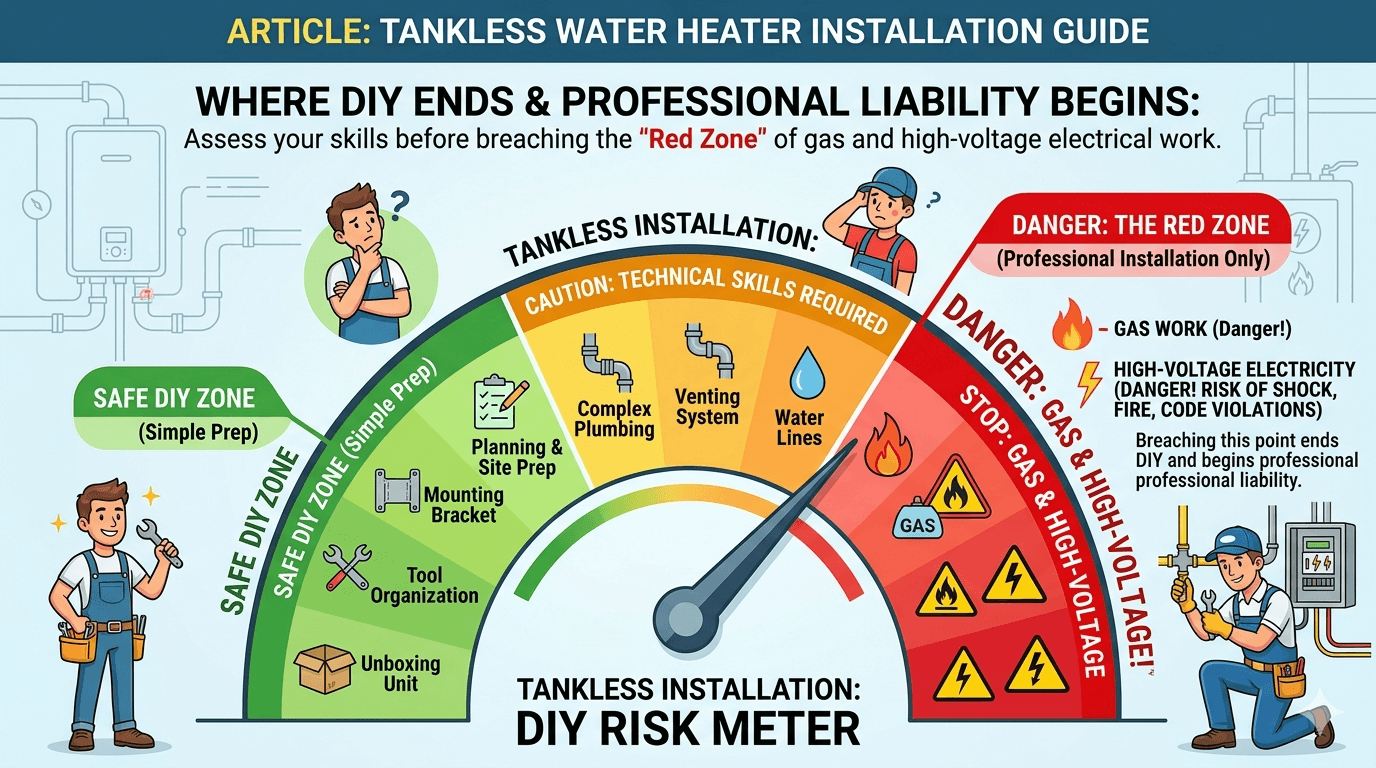
Where DIY ends and professional liability begins: Assess your technical skills before breaching the "Red Zone" of gas and high-voltage electrical work.
Ignoring the Florida Building Code (FBC) or manufacturer specifications does more than risk a leak; it legally voids the equipment warranty and complicates insurance claims [2]. While labor typically accounts for 50% of the project cost ($600-$1,850), that investment secures a "Certificate of Occupancy" level of safety [1].
The required investment is dictated by existing infrastructure. If a home was not designed for on-demand heating, the "hidden" costs of upgrading an electrical panel or gas line often exceed the price of the unit itself.
| Expense Category | Electric Unit | Gas Unit |
|---|---|---|
| Equipment Cost | $500-$1,500 [3] | $1,000-$2,500 [4] |
| Installation Labor | $45-$200/hr [5] | $1,638-$1,841 (Base) [6] |
| Materials (Venting/Pipes) | $200-$500 [7] | $200-$500 [7] |
| Permit Fees | $50-$200 [9] | $50-$200 [9] |
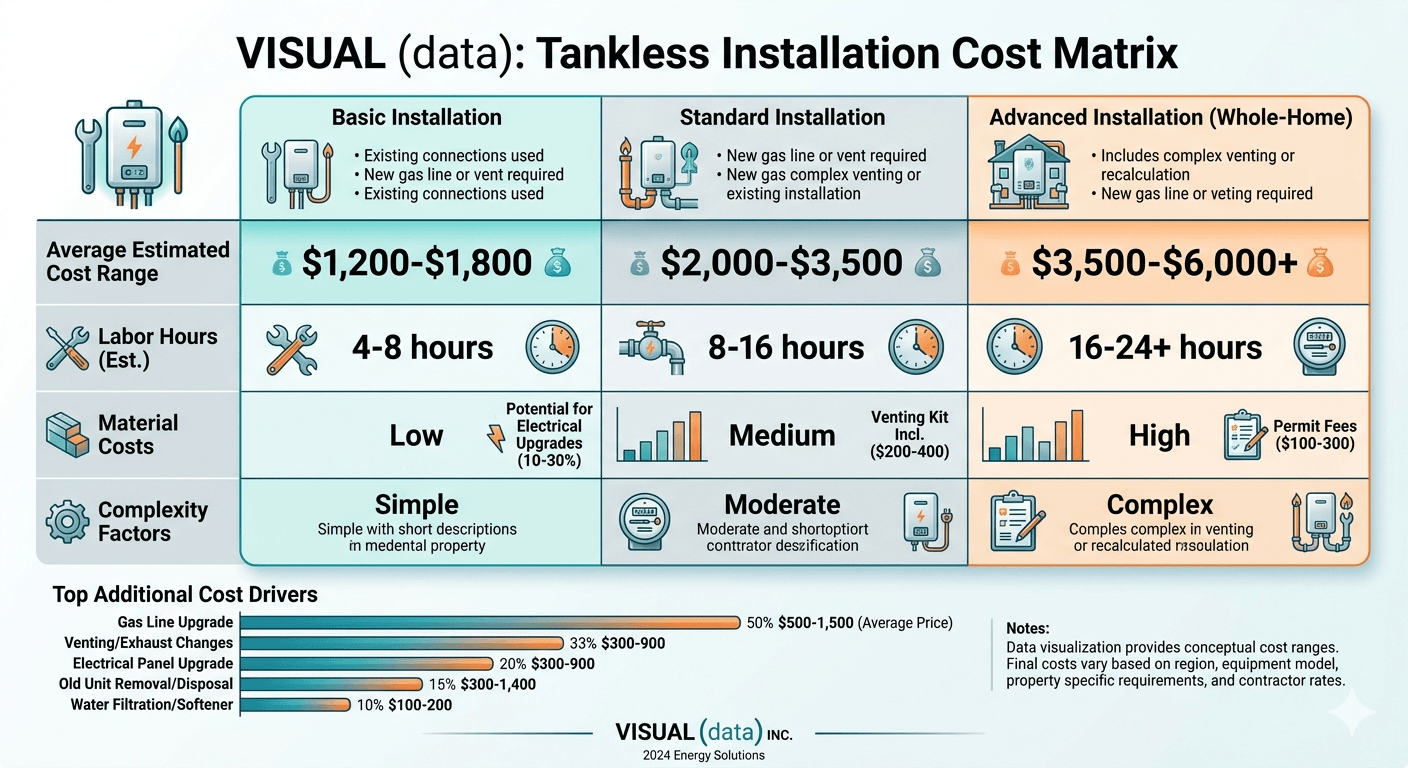
Real-world budget projections for 2025-2026: Comparing equipment costs against the often-overlooked infrastructure requirements.
Retailers focus on the box; we focus on the "Input Requirements."
Before selecting a model or installing tankless water heater units, we must solve the "Hydraulic Equation" for the specific household:
1. GPM (Gallons Per Minute): The concurrent load. If two showers and a dishwasher run simultaneously, the unit must handle that combined flow.
2. BTU (British Thermal Units): The measure of heat energy. Higher BTU ratings mean faster heating for gas units.
3. Delta T (Temperature Rise): The difference between incoming groundwater and the desired 120°F (49°C). In South Florida, groundwater is naturally warmer, requiring less "lift" than in northern climates.
4. Amperage/Voltage: Electric units are essentially "lightning in a box." They require 240V and frequently multiple dedicated 40A breakers [12].
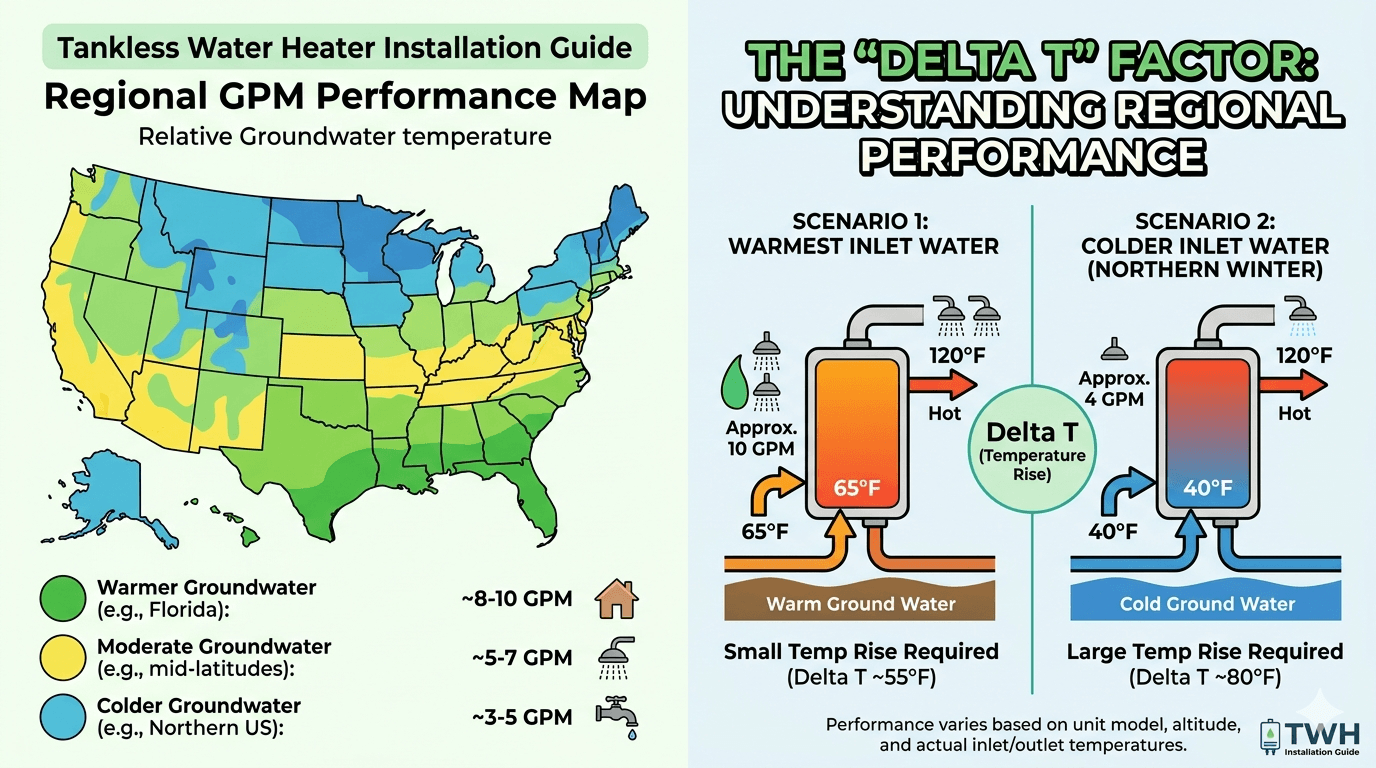
The "Delta T" Factor: Why a unit rated for 10 GPM in Florida might only deliver 4 GPM during a cold snap in the North.
While elegant, electric tankless water heater installation is power-intensive. A whole-home unit can pull up to 150A. If a home has a standard 150A total service, adding a 120A heater leaves almost no "headroom" for air conditioning or dryers [12]. We frequently recommend a dedicated sub-panel to manage this load.
Gas units are categorized by their exhaust handling:
For those wondering how to install tankless water heater systems correctly, the process follows a strict linear logic. A professional installation typically takes 4-6 hours, while a DIY retrofit can span 2-3 days.
The unit must be secured to a structural member. Per code, these cannot be placed in bedrooms or bathrooms unless they are "direct vent" sealed systems [14]. A 24-inch "service envelope" must be maintained in front of the unit for future maintenance [14].
This is the most common DIY omission. We must install isolation valves on the cold inlet and hot outlet. Without these, it is impossible to perform the annual descaling flush required to prevent the heat exchanger from clogging with mineral deposits.
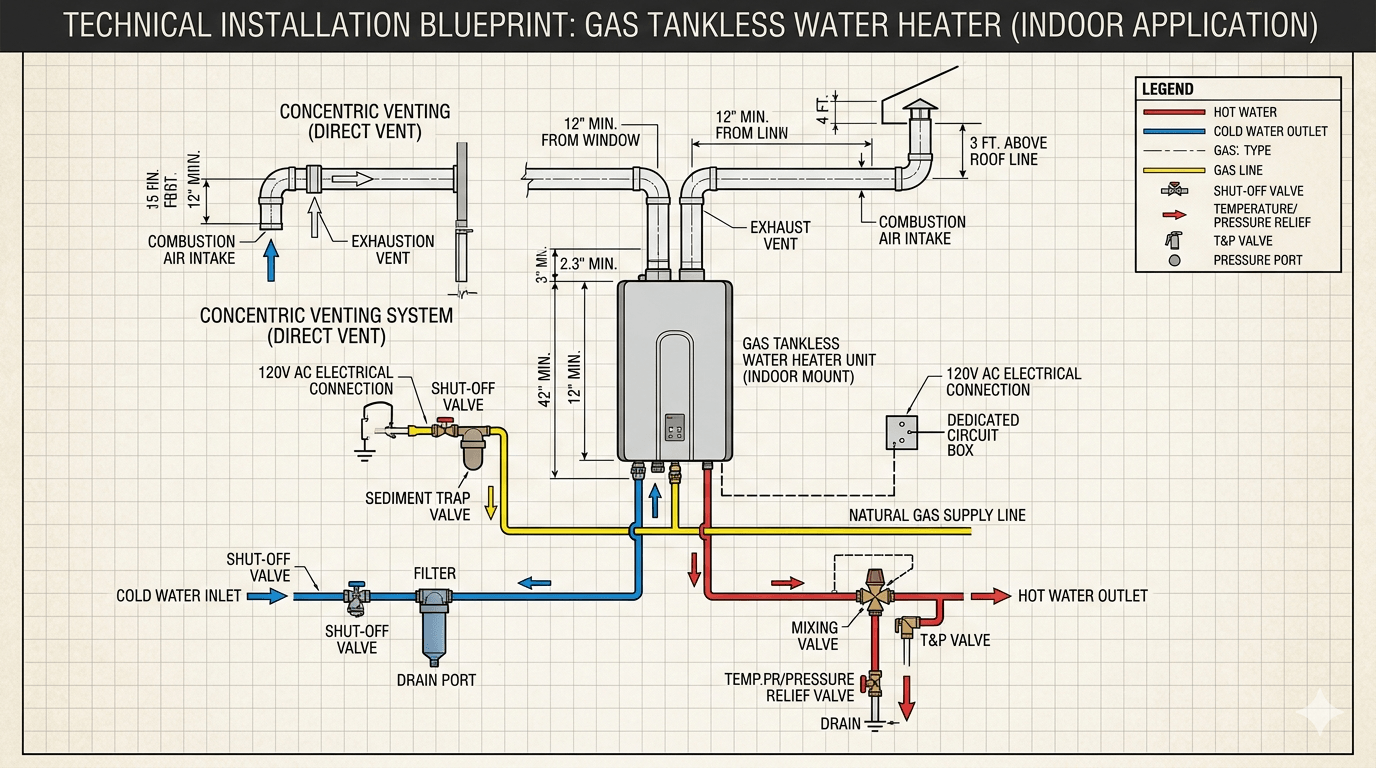
The "Perfect Setup": Note the placement of isolation valves, the T&P relief valve, and the sediment trap—critical for long-term system health.
1. The "Scale" Killer: In hard water areas, minerals plate onto the narrow copper passages of the heat exchanger. Without a scale inhibitor, efficiency drops 10-15% within months [16].
2. Short-Cycling: If the gas line is undersized, the unit will struggle to ignite, cycling on and off rapidly. This destroys the control board and igniter.
3. Improper Venting: Using the wrong pipe material leads to melting, fire hazards, or CO poisoning.
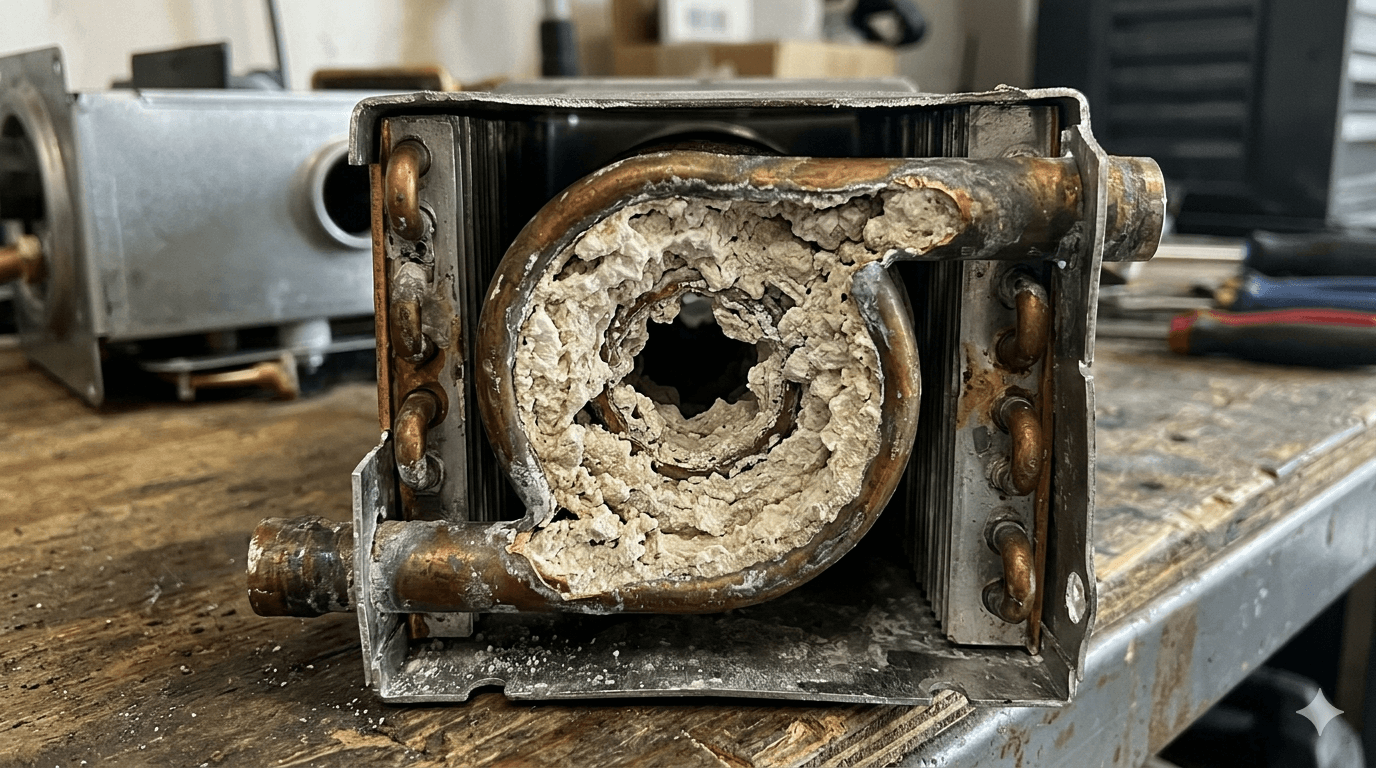
The reality of neglect: A cross-section of a heat exchanger choked by calcium deposits after just 12 months of operation without a filter.
There are scenarios where we recommend against this transition:
1. Audit your fixtures: Calculate your peak GPM (Showers + Appliances).
2. Check your "Fuel Pipe": Is your gas line 1/2" or 3/4"?
3. Open your Panel: Do you have physical space and electrical capacity for two to four 40A double-pole breakers?
Selecting a tankless system is an investment in your home's long-term efficiency, but it requires respecting the physics of the system. We have seen far too many homeowners pay twice—once for the DIY attempt and once for the professional rescue. Whether you choose to tackle this yourself or hire a specialist, remember that a water heater is only as good as the infrastructure supporting it. Take the time to verify your GPM needs and electrical headroom today; your future self (and your laminate flooring) will thank you.
[1] Plumber and Electrician Hourly Rates 2025 — https://elocal.com
[2] Legal Risks of DIY Installation — https://piedmonthvacpc.com
[4] Tankless Water Heater Installation Cost — https://homeadvisor.com
[5] Plumber and Electrician Hourly Rates 2025 — https://elocal.com
[6] Labor Estimates for Gas Water Heaters 2026 — https://homewyse.com
[7] Venting Materials and Costs for Tankless — https://monkeywrenchplumbers.com
[8] Venting Materials and Costs for Tankless — https://monkeywrenchplumbers.com
[9] Permit Requirements and Fines — https://vevor.com
[10] Electrical Panel Upgrade Costs — https://sumstrike.com
[11] Gas Line Installation per Foot — https://professional-plumbing.com
[12] Electrical Specifications for EcoSmart — https://ecosmartus.com
[13] Gas Pressure and Pipe Sizing (Rheem) — https://files.myrheem.com
[14] Clearance and Safety Regulations — https://rheem.com
[15] Condensate Drainage and Pipe Slope — https://apollohome.com
[16] Energy Efficiency and Short-Draw Losses — https://energy.ca.gov
[17] Energy Star UEF Standards — https://energystar.gov
[18] Lifespan of Tankless Systems — https://bradburybrothers.com
[19] Federal Tax Credits for Energy Efficiency (25C) — https://irs.gov
.png) Share
Share